

Gibson bass guitar bridge / tailpiece units are typically weightier than those employed by other manufacturers, with early examples height adjustable via heavy bolts into the guitar's body (the 'sustain sisters' as Gibson called them). These bridges are pretty effective (the three point bridge is still in use today) - despite some (especially the two-point versions) having a bad reputation. But most failings of the early bridges can easily be rectified with a little attention. Check out the detailed descriptions of Gibson bass guitar bridges, bridge covers and mutes below.
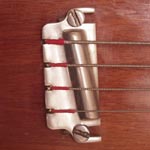
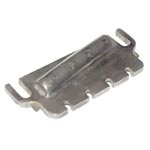
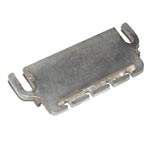
Gibson bar bridge - first version. Part number BR-655N. Nickel. Notice the straight, thin mounting arms. Although the strings can not be intonated individually, the whole bridge could be moved slightly, with adjustment of either of the hex-screws perpendicular to the bridge posts. As used on the Gibson EB bass, EB-0, EB-2, EB-3, and Epiphone Newport and Rivoli. Phased out in 1965, in favour of the chromed version, below. more
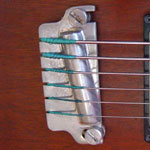
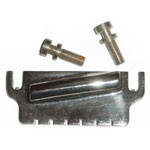
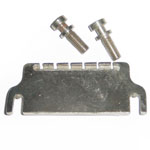
Gibson six string bass bar bridge. Part number BR-650N. Nickel. This bridge is the basically same as part number BR-655N above, except that it is made for Gibson's six-string bass, the EB-6, and the Epiphone equivalent the six-string Newport EBS-6. more
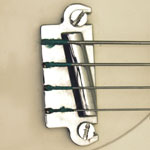
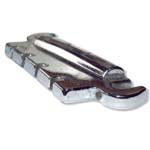
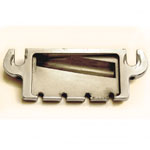
Gibson bar bridge - 1965 version. Part number BR-655CH. Chrome. Notice the rounded, wider mounting arms. Like the previous version, an approximation of intonation could be achieved by adjusting the hex screws. This bridge appeared on the EB3 in 1965, perhaps earlier, whilst the EB0 continued to use the nickel version (part BR-655N, above) until stocks were used. When the intonatable bridge came in in 1967, last stocks of this bridge were used on Gibsons budget brand bass; the Kalamazoo KB bass. more
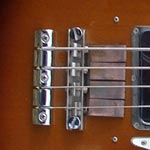
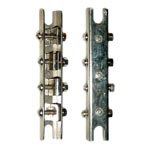

Gibson Thunderbird bridge (1960s). Part number BR-750N. This was Gibsons first bass bridge to allow separate intonation of each string, and was used on the reverse and non-reverse body Gibson Thunderbird, and the Epiphone Embassy from 1963-69. Unlike all other Gibson bass bridges, it required a separate tailpiece, and was fitted with a damper spring, which acted as a mute by pushing felt blocks (not pictured) against the strings. The bridge posts were short-bushing type, nickel (early) or chrome (later) plated
Even though this bridge was designed to be intonatable, in practise this was not always possible, leading people to reposition the bridge slightly. A replacement bridge by Scott Dasson (Dasson or Badbird bridge is currently available that resolves this issue, with no modifications necessary to the instrument itself. more
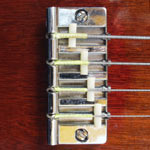
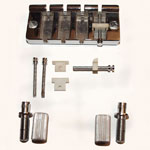
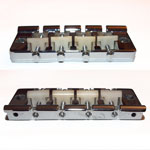
Gibson two-point Tune-O-Matic bridge. Introduced in around 1967, the two point bridge was Gibsons first attempt at a bass bridge that allowed separate intonation of each string. The bridge attaches to its posts by means of two hex screws. When posts or hex screws are worn, the bridge can tip forward to some extent (some people call this bridge the Gibson ever-tilt), which can cause problems with action, and intonation. This is common in basses with no under-bridge mute. Notice also that the silk wraps at the ball end of the string don't always stop before the bridge saddle, avoided, by removing some of the wraps with a razor blade, or better still buying strings with no wraps. Most versions had the nylon saddles pictured here, though around late 71, early 72 some of these bridges were equipped with chrome plated metal saddles. more
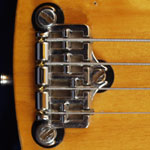
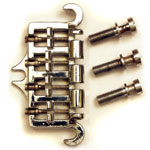
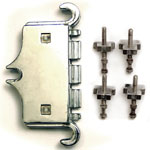
Gibson three-point adjustable combination bridge. Introduced in mid 1973, and still in use today. This bridge is a sturdy, heavy-duty bridge which overcomes the tendency of its predecessor to tip forward, by having an extra post at the front. The bridge pictured has black plastic surrounding each post hole - though this is the exception rather than the rule. As used on the EB-0, EB-3, EB-4L, Thunderbird, SB-350/SB-450, Ripper, RD series basses, Les Paul Signature and Les Paul Triumph from 1973 onwards. more
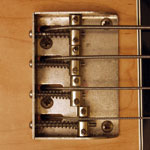
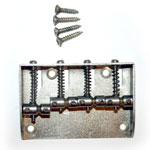
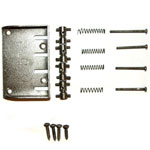
Gibson Grabber bridge. Part number 10149 (1977), 81554 (1981). As used on the Gibson Grabber and Gibson G3 basses. This simple Fender-style bridge was considerably cheaper to produce than the three-point (above) in use at the same time, and far more reliable than the SB bass bridge that was Gibsons previous budget version. Size: 2 5/16" x 2". Note the G-string screw is longer (1 1/2") than the other three (1 7/32"). The spring is also slightly longer to compensate for this. more
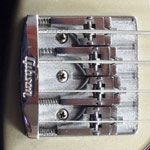
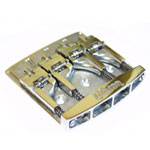
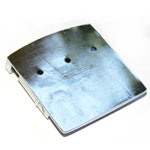
Gibson TRI-4 wedge bridge. As used on the Gibson Victory and Explorer basses. 1981 publicity for the Victory bass summed it up: For the ultimate in player adjustment we give you the TRI-4 bridge. We start with a chrome-plated heavy cast base plate secured directly to the body, but check out its versatility. You can adjust the bridge inserts forward and back for intonation, and you can adjust your individual string action height by moving it up or down. But the adjustment that pulls everything together into a total player package is the side to side adjustment. We preset the string spacing for you but you can change it to suit your specific needs. more
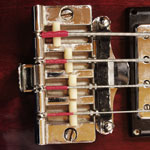
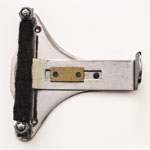
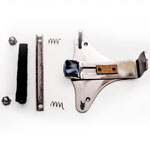
EB string mute Introduced in 1960 (see the Gibson Gazette July/August 1960 and 1962 mute patent) and fitted to Kalamazoo-built basses until 1971. This mute was widely used on practically all Gibson EB3s, and very many EB0, EB2, Epiphone Newport, Epiphone Rivoli and Les Paul basses. The principle was very simple: by pulling the lever away from the bridge, it's raised part pushes a piece of felt up, under the strings, dampening vibrations. Listen to these soundclips of a muted and unmuted Gibson EB3. more
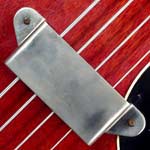
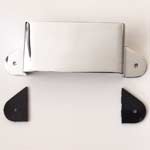
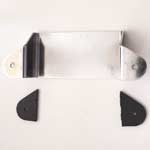
EB hand rest EB0, EB2, EB3, Epiphone Newport, Epiphone Rivoli, Kalamazoo KB bass. These hand rests were initially nickel plated, then chrome-plated from the mid 1960s, until their discontinuation circa 1968. more
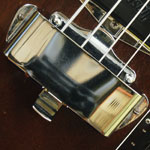
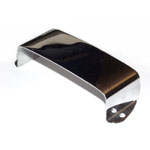
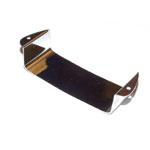
Chrome bridge cover Introduced in 1963 - the earliest (nickel plated) covers were only used on the Thunderbird. From around 1967-80 these covers (now chrome) were fitted to all EB, Thunderbird, Ripper and Les Paul basses. When under-bridge mutes were phased out in the early seventies, many of these covers had a strip of foam glued to the underside, which acted as a mute. To 'unmute' the cover would be removed. more
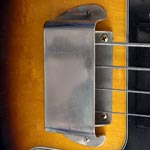
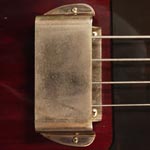
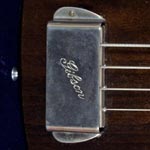
Nickel bridge cover (small) The smaller (but actually slightly wider) bridge cover used on the SB300/400, Grabber and G3 basses was not big enough to cover the two and three point bridges used on the majority of Gibson bass guitars; it was nickel plated, with an engraved Gibson logo in the early 1970s, but typically plain thereafter. In use 1971-1980. more
Gibson bass bridge for sale

Vintage Early 1960's Gibson EB-0 / EB-2 Bass Bridge Mute
Brooklyn, New York, 112**, UNITED STATES OF AMERICA
$175
Very Good Condition Sold by a mom & pop music store in Brooklyn NY
... more


1968 USA Gibson EBO Bass Guitar Vintage Bridge Base Part 1969 1970
Plano, Texas, 750**, UNITED STATES OF AMERICA
$225
... more
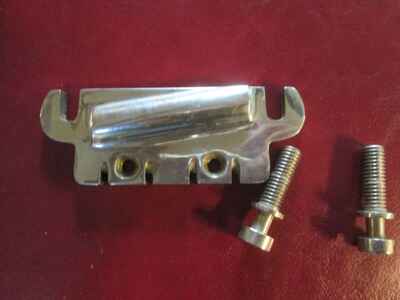
Gibson EBO Eb1 Eb2 Eb3 Bass Bridge Chrome Brass
El Cajon, California, 920**, UNITED STATES OF AMERICA
$150
$4 49 shipping to lower 48 states only.... more

Replacement 1970s Gibson Ripper electric bass guitar bridge with studs
Spring Hill, Florida, 346**, UNITED STATES OF AMERICA
$66
... more
Do you have or can you get a Chrome Bridge Cover for a 1970 Les Paul bass? If so, how much for the part? 808-250-2471
Does anyone know where I might find the fret dampening material that came on the original 1969 Gibson EB3 bass? Mine is gone and I would like to replace it.
Hi Don, the material is just thick felt - note there are different grades of felt for different applications - and the precise specifications of the originals are not published, but this seems to be pretty close. F3 felt is pretty rigid, but obviously gives if compressed. The original was approximately (it's hard to measure due to it's malleability and there may also be some variance) 6mm (approximately 1/4") x 8mm x 60mm - so a 1/4" thick sheet should give you plenty of material to cut several
Any Ideas on where to get some replacement felt for the mute? What is the material made of, how thick does it need to be?
I have a epiphone les paul special edition bass the bridge is a square one looks like the hip shot type this was the factory standard for this model. can I replace it directly with the epiphone/gibson 3 point bridge or would it require drilling?
Might you know where I might find the Hand Rest for my Newport Bass?, you mention it on your website: metal hand rest EB0, EB2, EB3, Epiphone Newport, Epiphone Rivoli, Kalamazoo KB bass. These hand rests were initially nickel plated, then chrome-plated from the mid 1960s. Thanks! Rick Lucero, Denver Co.