

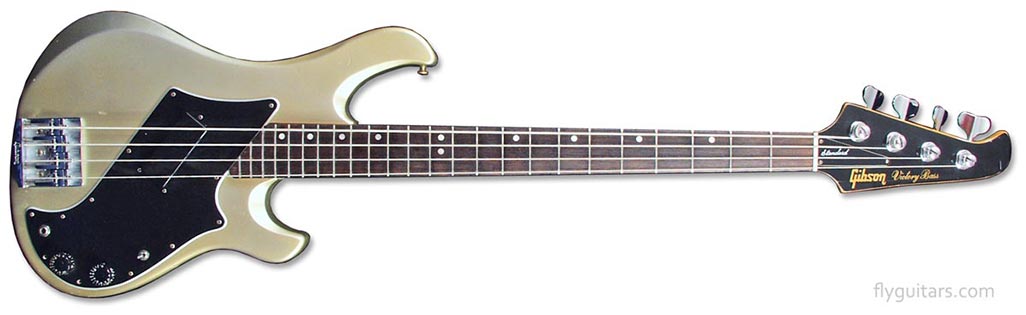
The Gibson Victory bass was launched in mid-1981, as a basic one-pickup passive model; the Victory Standard, and a two-pickup active Victory Artist. These were joined a year later by a two-pickup passive version, the Gibson Victory Custom. It was designed by the then Research and Development team, based in the Gibson Kalamazoo plant. The team was headed by Bruce Bolen, but the actual body/neck design was by Chuck Burge, and the electronics by Tim Shaw. Chuck was kind enough to talk to FlyGuitars about the development of the Gibson Victory bass.
Although designed in Kalamazoo, all but a few demonstration models were built in Gibson's newer Nashville plant starting in Spring 1981. This was, in fact, the very first bass line to be produced there.
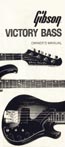
 >And now in 1981, the Victory bass guitars.
Your new Gibson Victory bass guitar is just that; a victory over the ordinary, the average, the "acceptable standards" for a bass guitar. A triumph of musical engineering, the Victory bass is as near perfection as the art of luthiery and "state of the art" technology will allow.
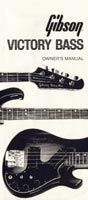
From the 1981 owners manual
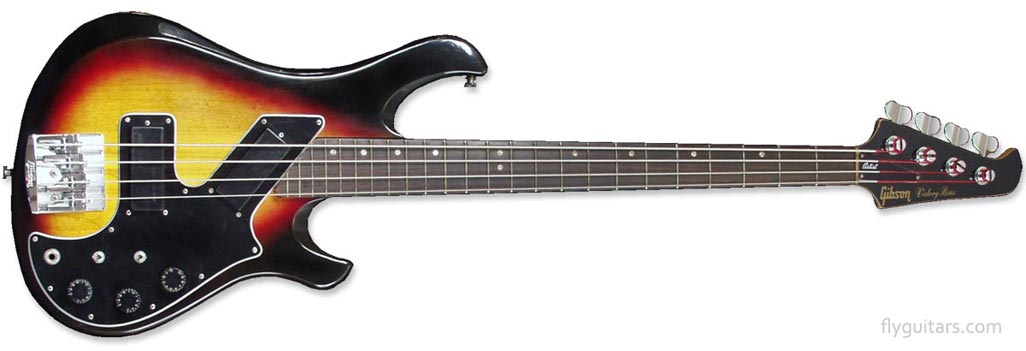
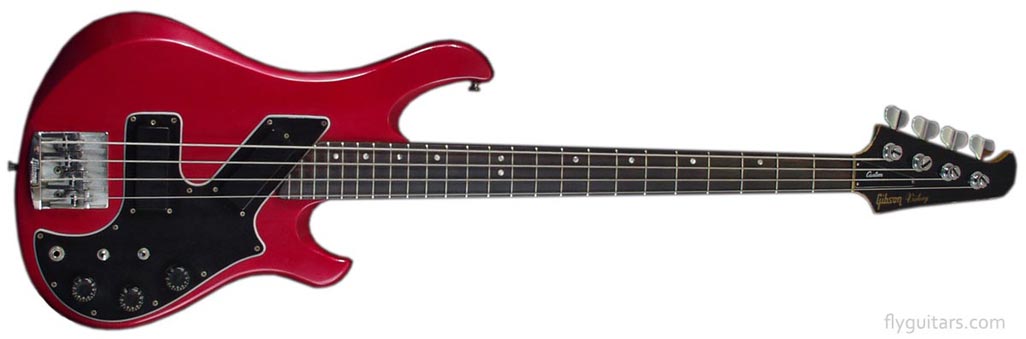
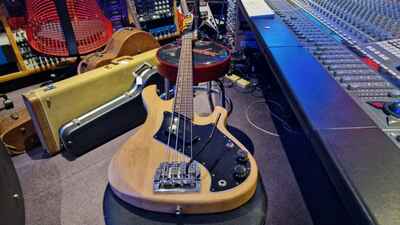
Stylistically, it was unlike any previous Gibson bass, asymmetrical with a deep lower cutaway, allowing access to the 24 frets, only the Thunderbird-esque headstock suggesting its heritage. It was Gibson's attempt to woo Fender Precision players. Chuck explains "It should be indistinguishable as to playability - where everything is, from a Fender P bass. Because they were doing it right, and everybody liked that"
It had it's share of improvements too though. It was Gibson's first two-octave long-scale bass, and the first to have a rectangular steel bar either side of the truss rod, to increase 'Structural rigidity'. They were the first basses to feature the TRI-4 wedge bridge - a style still in use today, and also the first to use the series VIIIB humbuckers. The owners manual explains...
>instead of using the traditional side by side placement of the humbucking pickup coils, an "end to end" coil placement design is incorporated. This enables each string to pass over only one coil of the pickup producing the pure, sweet, full frequency response of a true single coil pickup. However the pickups incorporate standard "humbucking" wiring to cancel the unwanted noise and hum frequencies unfortunately inherent in a simple coil pickup design
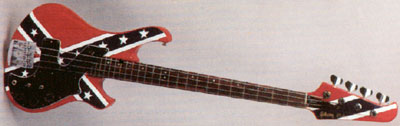
Gibson Victory Artist bass; the Rebel Victory. Taken from a 1985 flyer publicising the 'Designer Series'; a range of special effect finishes primarily for guitars - the Explorer, and Flying V - but also this one bass. The Gibson Invader guitar was also shown in rebel finish, with a Union Jack Explorer. The Rebel was a red guitar, front and back, with the rebel stripes applied on the front, and headstock only.

Furthermore the Victory Standard pickup used thinner diameter wire than the Artist, in order to "produce more mid-range and presence". The use of the series/parallel switch meant a wider range of available tones; the one-pickup Standard was a versatile bass with a number of distinct sounds. Only the Standard and Custom have this series/parallel switching facility, and as such have three wires (red, white, black) coming from the pickups (see Victory Standard wiring images), as opposed the the typical Gibson braided humbucker wire coming from the Artist pickup (see Victory Artist wiring images. Have a listen to the sound clips to hear how much difference this switch can make.
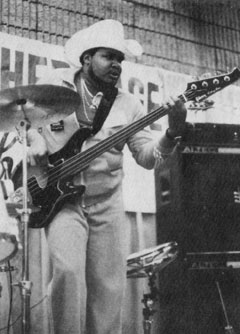 Gibson endorsing bassist Ralphe Armstrong, demonstrating the Gibson Victory bass (fretless in this case) at the Atlanta NAMM show, 1982. See the FlyGuitar Ralphe Armstrong interview
The Artist, of course, creates tonal differences electronically, without needing to use the series/parallel switch - and when played in passive mode sounds similar to the Custom. When in active mode the bass and treble controls can frequency boost by 16db or frequency cut by 18db - allowing a vast range of possible sounds, extreme treble to complete bass. Furthermore the notch filter offers a midrange frequency cut of 12db, providing another voice still.
Along with the pickups, the all maple construction, bolt-on neck, and brass nut of the Victory basses were more than capable of giving bass players of the eighties all the twangy treble that they could handle, as well as plenty of bass. The series was moderately successful, with high profile players such as Dave Kiswiney and Ralphe Armstrong endorsing the Victory Artist. As usual with Gibson basses, it didn't outsell the Fender Precision, and so fell by the wayside after five years. The 1986 price lists still have the Explorer bass, but the Victory is replaced by the IV, V and Q-90 basses.
Other notable players include Krist Novoselic (Nirvana) and Greg Norton (Hüsker Dü) the Victory Standard, and John Wetton (Asia) with the Artist.
Victory bass specifications
| Model | Standard | Custom | Artist |
| Available | 1981-1986 | 1982-1984 | 1981-1986 |
| Pickups | 1 series VIIIB humbucker (3 core wire - red, black, white - small diameter coil*) | 2 series VIIIB humbuckers (3 core wire - red, black, white) | 2 series VIIIB humbuckers (braided 1 core wire) |
| Electronics | Passive | Passive | Passive/active |
| Scale | 34" | ||
| Body | Eastern hard rock maple. Length 19 1/2", width 13", depth 1¾" | ||
| Neck | Three-ply maple neck with rosewood (plus the odd maple) fingerboard. Offset dot inlays. Width at nut 1.6875". 14 degree peghead pitch | As the Standard, but with additional brass nut. Necks are often unpainted, but not always. | |
| Hardware | One volume, one tone control, series/parallel switch, Gotoh machine heads | Volume, bass and treble controls, pickup selector switch, series/parallel switch, Schaller machine heads | Volume, bass and treble controls, pickup selector switch, 3-way mode selector switch, Schaller machine heads |
| Options | Fretless neck optional | ||
| Finishes | Silver Candy Apple Red Ferrari Red Ebony Antique Gold Rebel Victory | Antique Fireburst Candy Apple Red Ebony Antique Gold | Antique Fireburst Candy Apple Red Ferrari Red Ebony Antique Gold Rebel Victory |
* The Victory Standard humbuckers use thinner diameter wire, in order to produce more midrange and presence - see 1981 owners manual
Gibson Victory bass chronology
1981
April prices Standard (Candy Apple Red and Silver) $599
Artist (Candy Apple Red and Antique Fireburst) $799
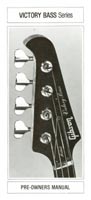
See the 1981 owners manual and pre-owners folder
June 1981 - two patents filed relating to the Victory bass: 269,524 (Victory bass design patent) ; 4,385,543 (Tri-4 bridge).
1982
All models now available in Ebony.
New model, the Custom added to the line (Candy Apple Red, Antique Fireburst and Ebony).
June prices - Standard $649, Custom $749, Artist $849
1983
January 1983 - All models now available in Antique Gold
Prices unchanged.
June 1983 - Patents 269,524 and 4,385,543 granted.
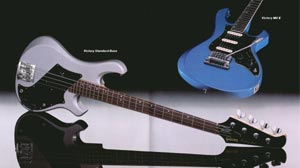
Victory Standard pictured in the 1983 Gibson catalog
1984
Prices unchanged.
Jan '84 - Prices unchanged.
June '84 - Custom deleted from price lists.
1985
Prices unchanged.
The Rebel Victory is announced in the Gibson designer series custom graphics flyer in the
February '85 - Silver and Antique Fireburst finishes discontinued.
June '85 - Antique Gold finish discontinued, Candy Apple Red is replaced by Ferrari Red.
1986
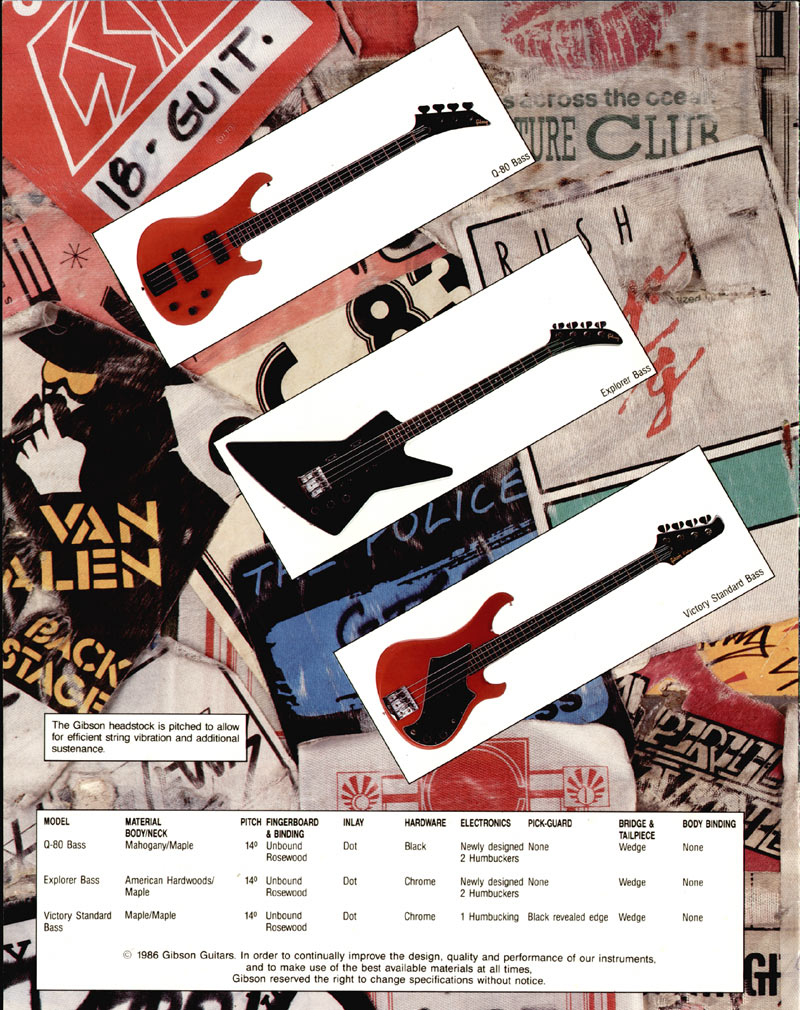
No Victory bass is listed in any 1986 price lists, though the Standard is shown in the 1986 catalog.
Gibson Victory bass FAQ
Frequently asked questions about the Gibson Victory bass
Were the electronics of the Gibson Victory a product of Bob Moog, as is the case with the Gibson RD Artist bass?
This is a common misconception - Bob Moog was not involved in the production of this bass. The electronics in the Gibson Victory series are the work or Tim Shaw, who devised these basses with Gibson Artist Chuck Burge (read about the development of the Gibson Victory basses).
Are shipping figures available for the Victory bass?
Someone, somewhere may have them, but nothing seems to have been published so far.
Gibson Victory bass for sale
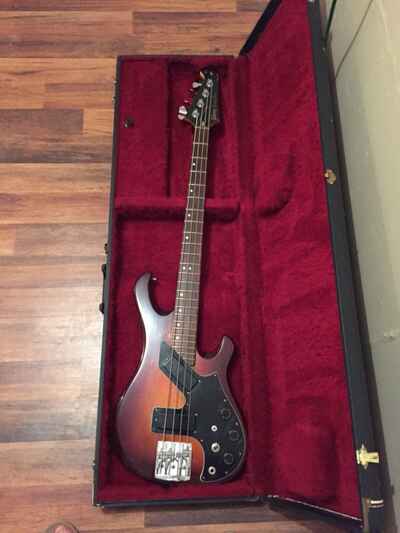
Gibson Victory Artist Bass 81'
Blackfoot, Idaho, 832**, UNITED STATES OF AMERICA
$3800


Vintage 1981 Gibson VICTORY STANDARD BASS with Original Case Candy Apple Red
Miami, Florida, 331**, UNITED STATES OF AMERICA
$1295

GIBSON VICTORY STANDARD BASS GUITAR
Saint Petersburg, Florida, 337**, UNITED STATES OF AMERICA
$1750
... more

Vintage 1981 Gibson Victory Standard Bass Guitar ~ Candy Apple Red ~ Nashville
Santa Ana, California, 927**, UNITED STATES OF AMERICA
$1300
Model: 1981 Gibson Victory Standard bassPickups: One Series VIIB humbucker Scale: 34 " Body: Eastern hard-rock maple. 19 1 / 2" long, 13" wide, 1 3 / 4" thick. Overall length 47 " Neck: 24 fret, two-octave maple bolt-on neck. Rosewood fingerboard. Width at nut 1 6875 " Hardware: Chrome throughout: TRI-4 wedge bridge, Gotah machine heads
Pleasetake advantage of the zoom feature on the photos to judge ... more

VINTAGE 1982 USA GIBSON VICTORY BASS GUITAR TUNER
Monza, 20***, ITALY
€50
Gibson used these on the Victory Standard and Victory Artist basses from 1981, and occasionally the Victory Custom later in 1982
Hard to find, very rare and no longer produced
Very good condition, see pictures
Price for one tuner, available 4 tuners
Private auction, non guarantee
European bidders please email me for postage costs
... more
Gibson Victory Bass 1981 Vintage USA Kahler Tremolo Thunderbird Headstock
Southend-on-Sea, SS1***, UNITED KINGDOM
£1999
Your statement " All but Ebony and Gold examples were fitted with natural necks.." is true for the most part. However, I have a Candy Apple Red that came from the factory with a matching neck. Serial #80552575. I had a roommate who worked in a music store and he told me about this bass when they received the first one in the store. I looked at it and ordered one the same day. I chose the red for my order but I don't remember if having a matching neck was an additional option or the only option for that color at that time. Unfortunately delivery kept getting delayed and the store got tired of me complaining so they gave me the number of their contact at the factory. I don't recall the name or position of the person I talked to but he was very sincere and appologetic about the delay. He told me the delay was due to a production problem. Because of the necks and bodies being produced and finished separately, they were not being finished with the same batch of paint. This was causing slight mismatches in the color between the two parts when they were assempled and they were not satisfied with the results. This lead them to decide to go with the standard maple neck for the Candy Apple Red (I don't know if this was true for other colors) from that point on. Knowing that I really wanted all red (as expected when I ordered) and that I had already been waiting months longer than promised by the store he vowed to do his best to find one. The one I finally received matched exactly and had an overall finish quality of perfection. I'm sure they are out there but I've yet to see another Candy Apple Red Gibson Victory Artist with a matching neck. It worked hard and never let me down. I finally retired it when I switched to 5-strings and was toying with the idea of selling it as I'm getting old and hate the idea of it getting left for someone to dispose of when I'm "gone". I've been trying to get an idea of what it's worth. Gar
Hello Gar, I am saving up to buy a red victory now. If you ever decide to let yours go. Let me know. I have been learning bass over the past year and love the design and have decided it will be my first nice bass. Hopefully whoever inherits your collection will appreciate it. i l i n c o l n at m a c dot c o m
I own an 84 Gibson Victory Artist W/active electronics It is a little heavy being made of Hard rock Maple But it when it comes to sound it is great sounding bass it will blow you away when you open it up The sustain from that hardwood can hold a note as long as your finger is on it I own 4 bad ass bass My Gibson Victory Artist. Fender Active Jazz Bass A peavey T-40 Bass and a G&L 2000 bass A real G&L not a tribute. The Gibson is my Favorite
oh yeah... and Ralphe Armstrong is the MAN!
That rebel Victory looks too cool. Gotta track one of those down.