

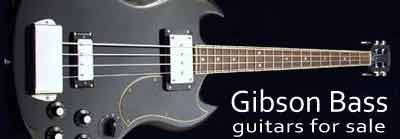
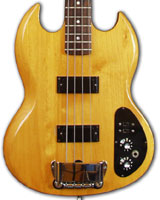
The Gibson SB basses were a range of short-lived low/mid priced SG-styled bass guitars, produced by Gibson in the early 1970s. There were four models in total, with the bulk shipped in 1971 (SB300 and SB400), and 1973 (SB350 and SB450).
Other than the brief appearance of the Melody Maker bass 4 years earlier, Gibson had not produced a budget bass model, but by the early seventies times had changed. The prevailing economic climate required instruments that could be built easily and cheaply, sold at an affordable price, yet retained the quality that Gibson was famous for, and Asian manufacturers were yet to acheive.
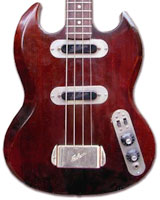
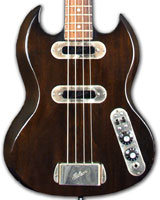
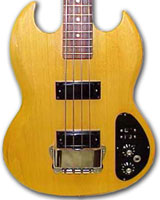
Solid Additions To The Gibson Line
what's new?
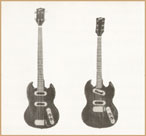
If your bag is Rock, Country, Bluegrass, or just plain blues, the exciting new SG-100, SG-200, SB-300 and SB-400, Gibson Solid Body guitars and basses are for you. Featuring a new concept in tonal response and body design, each model is equipped with the "bite" and appearance you would normally expect from higher priced instruments. Deep rich bass, clean, clear highs, it's all here at the touch of a finger
Taken from "what's new!" section of the 1971 Gibson Gazette (Vol. 11 #1)
In December 1969, Norlin took over from CMI, and the production of Epiphone models was moved to Japan. The Kalamazoo line was discontinued and Gibson developed a number of new models, including the SG-100/200/250 guitars and SB-300/400 bass, announced to dealers in February 1971. SB naturally stood for 'solidbody bass', in the same way SG stood for 'solidbody guitar'. These were still USA built guitars, produced in Gibson's Kalamazoo plant, that did not compromise (much) on build quality, or components.
Naturally, with the SG body shape, and translucent (Polycron) Walnut finish, these guitars look like a continuation of the EB-0/EB-3 bass series', however tonally these guitars are quite different. A combination of different woods (poplar body, maple neck) and hardware gave the SB series a bright sound; not as rich, but probably quite appropriate for the 70s rock scene As the 1971 publicity states "offers the "punch" required to support a group!". Compare the sound of the SB400 to a short scale EB0 and the neck pickup of a long scale EB3L.
1971 SB400
1970 EB0, played up at the neck
1971 EB3L, neck pickup, played right down by the bridge
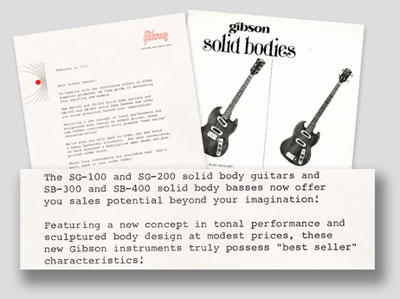
The Gibson SB300 and SB400 basses and SG-100 and SG-200 guitars were announced to dealers in February 1971, along with a SG/SB publicity sheet.
The SG-100 and SG-200 solid body guitars and SB-300 and SB-400 solid body basses now offer you sales potential beyond your imagination.
Featuring a new concept in tonal performance and sculptured body design at modest prices, these new Gibson instruments truly possess "best seller" characteristics.
The SB-300 and SB-400 were first listed in the June 1971 price list at $289.50 (whilst the EB-0 was $350), to be replaced by the SB-350 and SB-450 in October '72 at $299.50 (EB-0 was then $385). Prices rose to $310 in 1973, before being replaced by the Gibson Grabber in the February 1974 catalogue as Gibson's entry-level bass ($319). Gibson SB bass shipping figures reveal a total of 3607, produced between 1971 and 1978.
Budget? Yes. Low quality? Absolutely not!
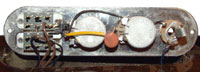
Gibson were very clever when it came to designing these basses. They certainly didn't skimp on the quality features that made Gibson famous. Set necks, high quality nitro-cellulose finish and good quality components. What they did do was to design pickups and circuitry that were used in a whole range of guitars, and could be assembled away from the bass (in a different plant in fact); reducing man/hours and reducing losses through unused components. The first version circuitry used in the SB300 and SB400 basses were also used in the SG200 and SG250 solid-body guitars and the ES-320 semi-acoustic. Likewise the second version circuit (mounted on a plastic, rather than chrome control plate) was also used on the SGII and SGIII guitars.
Another way Gibson reduced the cost of these basses was to simply follow fashion. Fender had been having massive success in the bass market using single coil pickups, and less-expensive woods, such as alder and maple rather than mahogany. These woods are known for their brighter tones; something the public seemed to like, so adding instruments made from them must have been a logical decision.
The two Gibson SB series'
Despite similar model codes, the two series were quite different, at least in relation to components used. Confusion is common in these models, and they are regularly misidentified.
Firstly the similarities. All models have a rosewood fingerboard, dot inlays, maple neck and transfer instead of inlaid logo. Body wood is most likely alder (although this was never specified for the 300/400). This is the first Gibson bass with a maple neck (the EB series went maple-necked in '72), and the first sold-body not made of mahogany.
The long scale (34 1/2") models SB-400, SB-450 have their bridge right back on the guitar body, beyond the tone control. This (and the neck itself) are the only differences between the long and short scale models. The two series themselves have a lot less in common, summarised in the table below.
| Scale | Pickups | Bridge | Available Finishes | |
| SB-300 | 30 1/2" | 2 Gibson single coil pickups (part 13570) | Multiplex adjustable bridge | Cherry, Walnut |
| SB-400 | 34 1/2" | 2 Gibson single coil pickups (part 13570) | Multiplex adjustable bridge | Cherry, Walnut |
| SB-350 | 30 1/2" | 2 Gibson SB humbuckers | Gibson two-point, later Gibson three-point | Cherry, Walnut, Natural |
| SB-450 | 34 1/2" | 2 Gibson SB humbuckers | Gibson two-point, later Gibson three-point | Cherry, Walnut, Natural |
Gibson SB bass guitars for sale

Beautiful Original 1971 Rare "GIBSON SB-40 BASS" Walnut Color wit Hardshell Case
Riverside, California, 925**, UNITED STATES OF AMERICA
$2795

If anybody is interested, I have original parts for the SB-300 for sale. 1. Complete pickups (2) 2. Bridge with new saddles 3. Complete control unit with original chrome plate, pots, switches, knobs and input jack. All these parts came off a working Gibson SB-300. Contact me with any questions. trailertrash1974@bellsouth.net
Regarding the SB bodies - I've restored several SB Basses over the last 30 years and all of them had poplar bodies, not maple or alder.
Your commentsI bought a ‘73 SB-450 last December. Absolutely love it. The neck is smooth and fast. The only negative is that the body is so light, the headstock drops as soon as you release the neck. They may have been “budget” instruments, but the build quality is great.
I have a SB-300. Does anyone know where I might find a replacement Truss Rod?
So were these imports?
Hi Stephen - No! absolutely not. These basses were built at Gibson's Kalamazoo plant. Michigan U.S.A. They really are a midpoint between the EB basses of the 1960s and the Grabber/G3/Ripper of the 1970s.
I'm looking for a End Pole Stand for a Epiphone EB-1 Bass Guitar. Plays like a Upright Bass.