

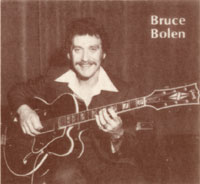
The RD Artist was launched in late 1977, after two years of development (see the RD Artist timeline), as Gibson's first active bass guitar (see also the passive RD Standard). According to the Gibson product development director at the time, Bruce Bolen, it had been designed from a "musical purpose" point of view, "to determine what the musical instrument is supposed to accomplish".
Gibson had worked closely with Moog (at this time both companies were subsidiaries of Norlin) and Who bassist John Entwistle, to create a bass that would benefit from the newly emerging electronics being fitted to basses by manufacturers like Alembic. Bruce Bolen explains, in this 1978 quote, some of the vision behind the RD Artist.
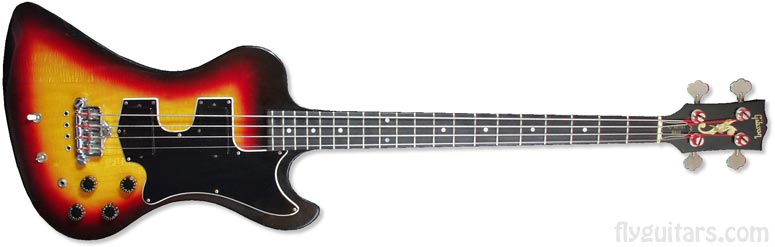
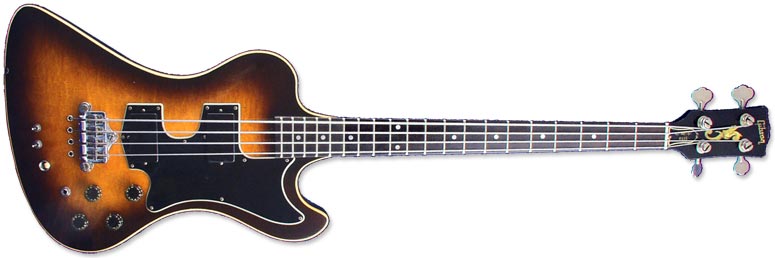
Two versions of the RD Artist bass. Above: 1978 Gibson RD Artist bass (RD77) in Fireburst finish. Below: 1981 RD Artist bass (RD79) with Curly Maple Top - in Antique Sunburst
 One of the particular musical qualities that I personally was looking for in one of the models, was a similar effect to that of a steel player - this being the reduction of the initial attack and the swell of the note after the initial attack had been made. A steel player of course uses a volume pedal to accomplish this but it was still something missing. Bob designed a special circuit that would achieve this as well as an expansion circuit unlike any other that had been designed to date.
The actual design of the RD bass itself (i.e. excluding electronics) was the work of Bruce Bolen, head of the Kalamazoo research and development group, with a design patent filed in May 1978, and granted in August 1980. Previously, most Gibson basses could be considered as extensions of a successful guitar line; the fact that the design patent is for the Artist bass strongly suggests, for the RD series it may have been the other way around.
It was a very high quality instrument with a terrific array of sounds, but John Entwistle soon stepped away from the project. It didn't sell in huge numbers, but did replace the Ripper as Gibsons best-selling bass of 1978 and 1979.
The RD artist first appeared in the 1978 RD catalog and then the 1978 Quality/Prestige/Innovation catalog, along with the RD standard, and a range of RD guitars.
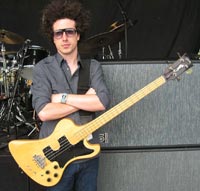
Justin Meldal-Johnsen: "the basic tone is cool, particularly with flats". Read more in the FlyGuitars JMJ interview
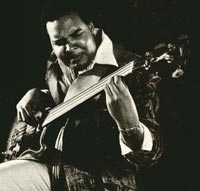
Ralphe Armstrong: "I liked because it was big and it had a long fingerboard; you can play a G harmonic on it and it had a big sound". Read more in the FlyGuitars Ralphe Armstrong interview

Krist Novoselic plays and records with several Gibson basses. In the Nirvana days he was regularly seen with a Gibson Ripper, and as pictured here, a black RD Artist bass. Image courtesy Brad Barrish, whatevernevermind.com
RD Artist controls
The four dials on the active RD guitars were a volume for each pickup, as would be expected, a treble control, and a bass control. The unusual thing about the bass and treble controls was that they operated in the range 5 to -5, with 0 being the neutral position. Listen to this clip - it demonstrates the RD bass at its most mellow (neck pickup, bass 5, treble -5) and then again at its most brash (bridge pickup, bass -5, treble 5 expansion and bright mode). This was recorded with a second version Artist bass; the earliest versions were not able to employ expansion and bright mode simultaneously. These sounds are extremes, but the RD can do anything in between.
Gibson describes the first-version RD controls in the RD-77 owners manual, and the 1978 RD control description flyer. For differences between the first and second versions, see the 1978 RD Artist and 1981 RD Artist pages.
Expansion, compression and bright mode circuitry
The RD Artist requires a 9 volt battery to operate; it has no passive mode. When the input jack is removed from the instrument it draws no power, so to prolong battery life, it should be left unplugged when not in use.
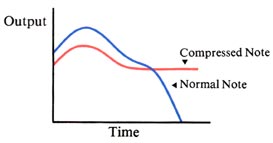
Compression - neck pickup only. As can be seen in the graph, compression reduces the fundamental attack, and 'compresses' each note into a long sustaining signal.
Listen to this clip of the RD Artist neck pickup (bass 0, treble 0); the first few notes are without compression, the second few notes are with. Notice the way the second clip sustains for significantly longer.
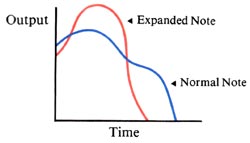
Expansion - bridge pickup only. Offers a very fast, explosive response, with a rapid decay.
Listen to this clip of the RD Artist bridge pickup (bass 0, treble 0); the first few notes are without expansion, the second few notes are with. Notice the difference.
When both pickups are selected, the neck will undergo compression whilst the bridge is subject to expansion
Bright Mode - affects the output of either (or both) pickup, and as the description suggests, accentuates the treble frequencies. This final clip demonstrates both pickups (bass 0, treble 0), without, and then with the bright mode activated.
Gibson RD bass guitars for sale
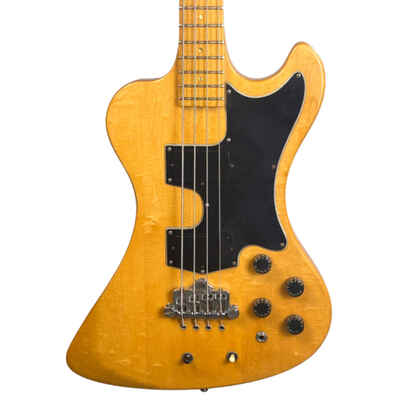
Gibson RD Artist MOOG 1978 Natural Maple 4-String Bass w / HSC (Used)
Sedalia, Missouri, 653**, UNITED STATES OF AMERICA
$4000

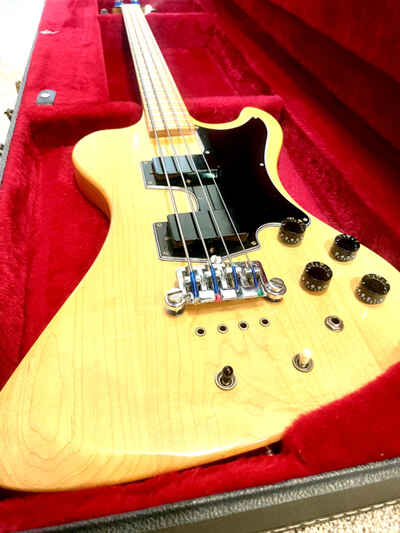
1978 Gibson RD Artist "NATURAL BLONDE" Electric (MOOG) Bass + OHSC
San Jose, California, 951**, UNITED STATES OF AMERICA
$4000
" NATURAL BLONDE" FINISH
GIBSON NORLIN-ERA
Original MOOG ELECTRONICS
Made in USA (Kalamazoo Plant, MI)
Production # 102 (April 17th release)
Adult owned only. Children-free, Pet-free household. Kept inside case when not used
Up for sale is a BEAUTIFUL LATE-70's Gibson Bass Guitar (RD ARTIST)
EXCELLENT overall vintage condition. Standard surface scratches, light dings, marks on front / back body / ... more

1980 Gibson RD Artist Bass Sunburst
Antioch, Tennessee, 370**, UNITED STATES OF AMERICA
$3999
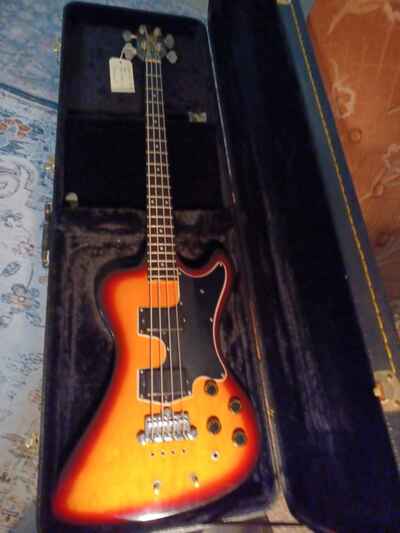
Gibson RD Artist Bass
Kennewick, Washington, 993**, UNITED STATES OF AMERICA
$3795
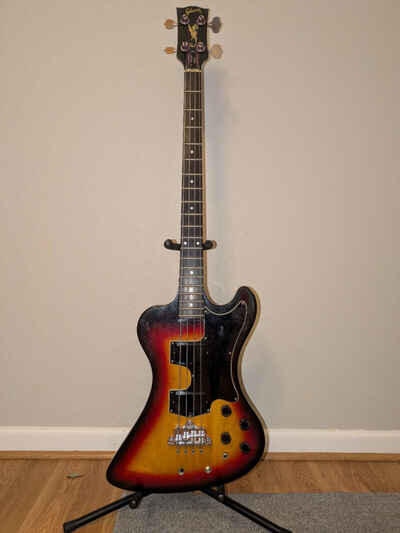
Gibson RD Artist Bass
Kitty Hawk, North Carolina, 279**, UNITED STATES OF AMERICA
$2999
... more