

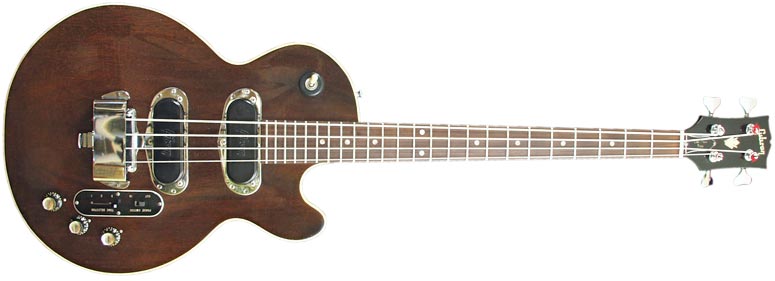
• Solid British Honduras mahogany body • three-piece British Honduras mahogany neck • Brazilian rosewood fretboard with dot inlays • 30 1/2 inch scale • translucent Walnut finish • 24 fret two octave neck
The Les Paul Bass is often termed the Les Paul Recording, or the Les Paul Professional however these were names of guitars; Gibson literature of the time only ever describes this model as a Les Paul Bass (have a closer look at a 1969 Les Paul bass). It was a companion model to the Les Paul Personal and Les Paul Professional guitars, and all shared the same basic construction and wonderful Walnut finish with similar style components. Pickups were specially designed by Les Paul; low impedance for unimpeded signal transmission in the studio, with distinctive metal surrounds.
Les Paul Bass development
The Les Paul guitar was having somewhat of a revival in the late 1960s with the reissue of the classic fifties Les Paul Standard and Custom models in 1968. But Paul was constantly innovating and experimenting with guitars, electronics and recording techniques; his low impedance pickups and associated circuitry finding their way into prototype Les Paul guitars and basses in the same year. These fascinating instruments don't quite have the same Les Paul body styling, but are quite similar in terms of electronics, hardware and construction.
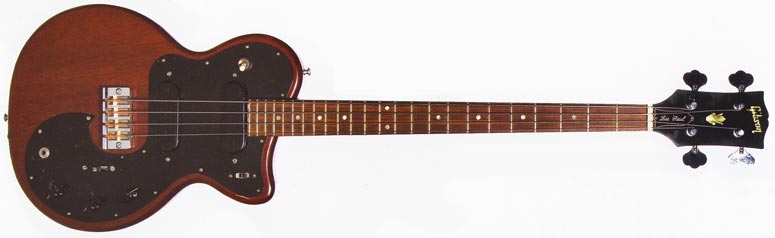
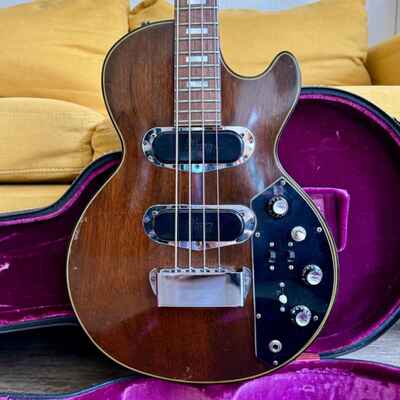
The bass shown above is one of the 1968 prototypes of the Les Paul bass from Les Paul's personal collection. It is all-mahogany with a set neck, 2 octave 24 fret rosewood fretboard and low impedance circuitry. It was sold by Julien's auctions in 2012. At least one more example is known to exist, and there are most likely others.
Production model
The production bass retained the classic Les Paul shape, but gave it a new look with a rich translucent walnut finish, chrome pickup surrounds and no scratchplate. Like the prototype, it was the first Gibson bass with a two octave, 24 fret neck, however the neck joins the body at the 19th rather than 16th fret, making those higher frets pretty hard to reach. It was also a very heavy instrument; presumably not seen as too much of an issue by Gibson, being designed primarily for recording use, but, Les Paul was not happy with the weight or the scale length. The weight was reduced with the next incarnation; the very similar Les Paul Triumph bass (designed not just for the studio, having a low/high impedance switch for use in live and studio situations), whilst the longer scale was finally realised with the 1973 Les Paul Signature.
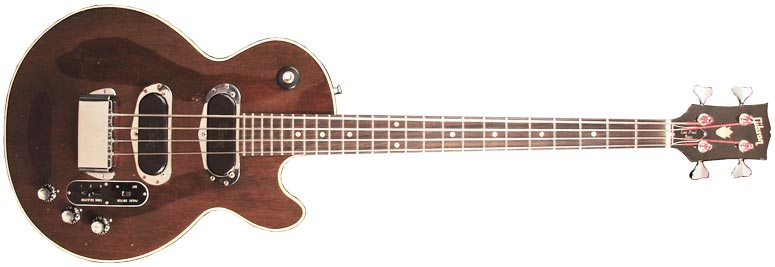
The production run of this model was sufficiently short to rule out any significant specification changes, though there is one difference between the latest examples (certainly those shipped in 1971, see a 1971 Les Paul Bass, above) and the majority of production: the removal of the string mute; this was occurring simultaneously in all Gibson bass models; the percussive string bass sound desirable in the 1950s and early 60s was just not relevant to the typical '70s rock bassist.
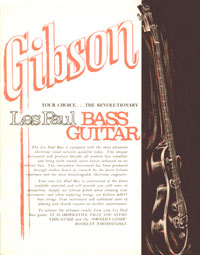
Like all other Gibson guitars of the period, the Les Paul Bass was manufactured at Gibson's Kalamazoo plant, MI, USA, with a little over 1000 instruments shipped between 1969 and (perhaps) 1976. The vast majority had already been shipped though by mid 1971. In late 1971 the Triumph replaced the Les Paul Bass in price lists, but it would not be surprising to find small numbers of the original design shipping over the following few years. Shipping statistics for this model are unclear, as Kalamazoo seems to have lumped the two models together until 1975, though it does suggest a tiny number of Les Paul Bass as late as 1976. Statistics for the Les Paul bass and Triumph are available here.
As this is a low impedance instrument, it requires a low impedance amplifier, such as the LP12 that was launched at the same time. The LP12 was an LP1 preamp, with an LP2 cabinet. Another option was to use a Gibson AD1 low-to-high impedance transformer cord. The Shure A95U is a modern day equivalent. This bass was eventually replaced by the Les Paul Triumph bass in the early 1970s.
The production run of these basses was short, so few changes appeared within the model, and those that did all related to the hardware fitted: early models have the Gibson underbridge mute, and post 1970 models also have 'made in USA' stamped into the back of the headstock. The tuning keys were Schaller M4 type, throughout the production run, with the majority having the typical '60s 'G' logo on the gear covers, though the final examples typically had the whole word 'Gibson' instead. Serial numbers appear in the range 83**** to 96****, with lower numbers shipped before higher (please contact FlyGuitars if your Les Paul bass has a number outside of this).
The Les Paul bass first shipped in 1969, but was first featured in 1970's series of catalogues. It appeared in the 'Les Paul' booklet rather than the basses booklet and was listed at $495; more than the EB0 ($350), EB1 ($395), EB3 ($410), but still less than the EB2D ($510). The bass was described as follows:
The frequency response, range of harmonics and crisp clear tones of the LP bass will exceed that of any electric bass on the market to date. This instrument is the only bass equipped with two low-impedance, humbucking pickups, and the slim single cutaway design is especially popular with today's groups.
FEATURES: low impedance electronics and pickups. Clear grain British Honduras mahogany with center crossband body construction. Three piece laminated British Honduras mahogany neck construction. Buffed and polished clear walnut finish reveals all the fine grain-lined features of the basic wood. Brazilian rosewood fingerboard. Chrome-plated Schaller machine heads with sealed gears. Nickel-plated Tune-O-Matic bridge. 18¼" long, 14" wide, 2" deep; 30 1/2" scale, 24 frets
Well known users of the first incarnation Les Paul Bass include Suzie Quatro, Mike Watt and Gene Simmons.
Les Paul Bass Frequently asked questions
What strings were recommended for the Les Paul bass? Originally the Triumph was shipped with Gibson brand 0055 strings; flatwound, medium gauge: .048, .054, .076 and .095.
What is the recommended action for the Les Paul bass? First fret: E string 2/64", G string 3/64", twelfth fret: E string 8/64", G string 10/64".
Gibson Les Paul bass guitars for sale
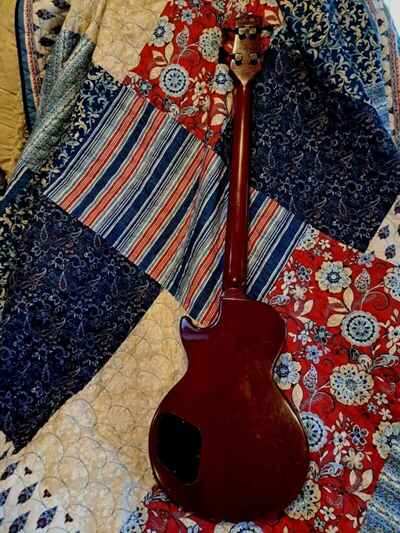
gibson les paul bass guitar
Ronkonkoma, New York, 117**, UNITED STATES OF AMERICA
$1250
... more

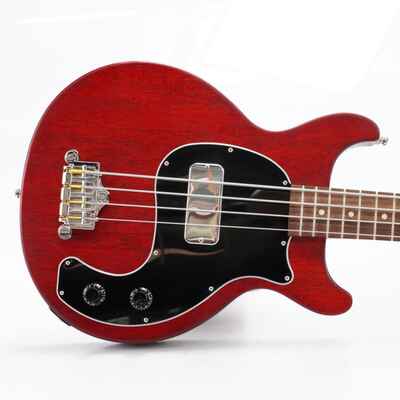
Gibson Les Paul Junior Tribute DC Worn Cherry Bass Guitar w / Gig Bag Case #53535
North Hollywood, California, 916**, UNITED STATES OF AMERICA
$1195
eBay Template Design by OCDesignsOnline HomeAboutTestimonialsPoliciesContactSell your Gear Gibson Les Paul Junior Tribute DC Worn Cherry Bass Guitar w / Gig Bag Case #53535 ××××××××××××××××××××××××××××××××××× Item DescriptionWORKING CONDITION: Excellent - Plays great. Set up nicely with perfect action and ... more
1972 Gibson Les Paul Triumph Bass Walnut
Tarzana, California, 913**, UNITED STATES OF AMERICA
$3400
Up for sale, an incredible and unique 1972 Gibson Les Paul Triumph Bass in a Walnut finish. Norlin era. Made in Kalamazoo, MI USA. All Original, stock with its Black tolex hard case.
11 0 Lbs, which is average for a Les Paul Bass
This short scale bass guitar has an Incredibly comfortable Mahogany body and neck with rosewood fretboard. No volute, perfectly straight, allowing low action playing well all across the fretboard.
The two low ... more

ORIGINAL VINTAGE 1970s Gibson Les Paul Triumph Recording Bass Walnut Orig. Case
West Islip, New York, 117**, UNITED STATES OF AMERICA
$3850
HAS AMAZING TONE AND SOUND WITH A REAL NICE SMOOTH FEEL AND ACTION ALL TUNERS, ELECTRONICS, GIBSON PICK UPS, SWITCHES, VOL , TONE. WORK REAL WELL ALSO AS SHOWN HAS A TINY HAIRLINE ON GUARD BY INPUT JACK CONSIDERING THIS GEM IS APPROX. 50 YEARS OLD AS SHOWN IN REAL NICE ORIGINAL CONDITION BUT TO BE EXPECTED TO HAVE SOME SCUFFS, SCRATCHES AND NORMAL USAGE WEAR .PLEASE ... more

1991 Gibson Les Paul Bass Guitar | Rare | Transparrent Red | Preowend | GITA
Mansfield, NG18***, UNITED KINGDOM
£1995