
In the 1960s, Gibson had an agreement with it's dealers that limited the number of outlets in an area. The Epiphone brand was a way of selling guitars to more dealers without breaking the terms of these arrangements. Until 1970, these instruments were American-made; built side by side, with Gibsons, in the same Kalamazoo factory, using the same materials and techniques, and by the same workers.
So most Epiphone models of this period share basic hardware with a Gibson model, and are built of the same materials. The Epiphone Newport was effectively a differently shaped Gibson EB0; both lightweight 30 1/2" scale basses with a very fat sound.
The Newport was CMI Epiphone's most successful bass. Outselling the hollow-body Rivoli in all years except '67 and '68, and shipping a total of 2658 instruments between 1961 and 1969. This was, however, just a fifth of the number of EB0 basses shipped in the same period. (Newport shipping figures | EB0 shipping figures)
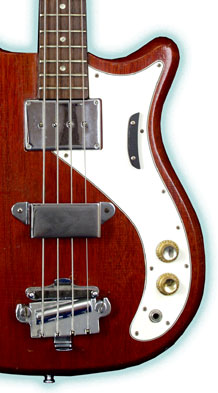
So how are they similar? Short scale. Mahogany body, set one-piece mahogany neck, rosewood fretboard with dot markers, single EB humbucker, Gibson bar bridge (and later two point bridge)
So do they differ? Obviously a different shape, different scratchplate and control knobs. Epiphone logo is a decal rather than inlaid (actually the Newport Deluxe has an inlaid logo).
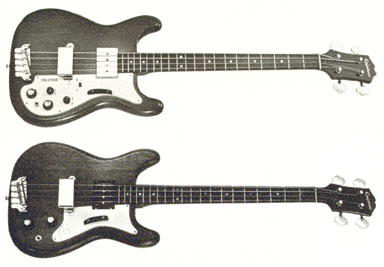
Two Newport basses, above - the EB-SF, or Newport Fuzztone from 1962. Below - the 1961 Newport, as it looked in 1961
There were four Newport variants:
- Newport EBS - A straightforward one pickup EB0 equivalent
- Newport Deluxe EBD - A two pickup EB3 equivalent, but with no varitone
- Newport EBSF - An EB0F equivalent, with fuzztone
- Newport EBS6 - A six-string equivalent to the EB6
Only the EBS sold in any real numbers, and the other three Newport versions were quickly discontinued; the EBD and EBSF in 1963 and the EBS6 in 1965. The EBS did sell fairly well though particularly in the mid sixties.
In 1964 the stylish new batwing headstock replaced the 2x2 arrangement on most solid body Epiphone guitars and basses; a feature that got noticed and made the Epiphone range look that little bit more interesting. Sales, in fact, rose sharply at this point.
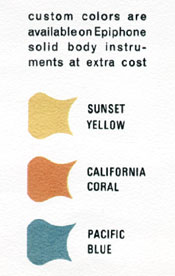
As well as Cherry, Epiphone solid-bodies were available in three optional colours: Sunset Yellow, California Coral and Pacific Blue. Early price lists also offer another colour 'Red Fox' alongside Cherry (also available on the Wilshire), but never mentioned in catalogues.
Epiphone Newport sound clips
The Newport has the same construction from the same materials as the EB0 - both basses are characterised by the warmth of rosewood/mahogany and the depth of the super-hot EB neck humbucker:
Shipping figures for Epiphone Newport EBS, EBD, EBSF and EBS 6 bass guitars
The Newport shipped in relatively small numbers compared to the Gibson equivalent model, the EB-0 (see the Gibson EB-0 shipping figures). In the 1960s, just over 2500 Neport EBS basses were shipped; just one fifth of the almost 13000 EB0s shipped. The simple single-pickup Newport was available between 1961 and 1969, with other variations available until 1965, but in very small numbers.
| 1961 | 1962 | 1963 | 1964 | 1965 | 1966 | 1967 | 1968 | 1969 | total | |
| Newport EBS | 118 | 145 | 148 | 612 | 563 | 664 | 136 | 65 | 72 | 2523 |
| Newport Deluxe EBD | 25 | 26 | 38 | 89 | ||||||
| Fuzztone Newport EBSF | 1 | 24 | 25 | |||||||
| Six String Newport EBS 6 | 10 | 7 | 4 | 21 |
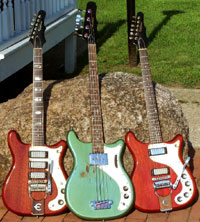
1965 Pelham blue Epiphone Newport bass, shown here with rather nice Epiphone Crestwood Deluxe, and Wilshire six-string guitar models. Unfortunatly the shipping figures do not split by colour, but the vast majority of Newports were Cherry; this bass is something of a rarity. Notice how the yellowed clear-coat has turned the once-blue colour, a turquoise-green.
More

The early two-pickup Newport, with 2x2 headstock and symmetrical body.

The later 'batwing' headstock style.
Epiphone Newport pricing and publicity. Original retail prices, and Epiphone catalogues featuring the Newport.
Epiphone Newport bass for sale
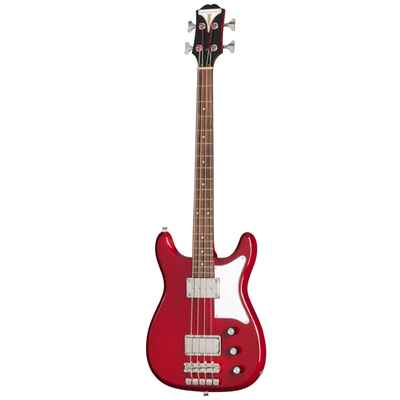
Epiphone Newport 4-String Bass, Laurel Fingerboard, Cherry
National City, California, 919**, UNITED STATES OF AMERICA
$329
Description
An Epiphone Original From the Early 60s Returns
The Epiphone Newport Bass is an all-original design that debuted in 1961. The modern Newport Bass pays tribute to that rare vintage model while offering refinements to meet the needs of today??s bassists. The 30 5?? ... more

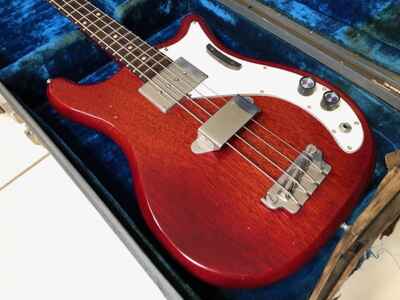
Vintage 1964 Epiphone Newport bass guitar and case 100% original
Costa Mesa, California, 926**, UNITED STATES OF AMERICA
$2499
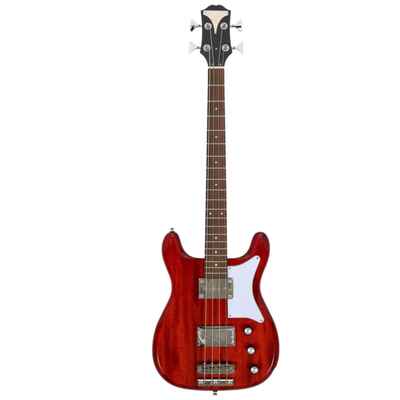
Epiphone Newport Bass Cherry B-Ware - E-Bass
Walldorf/Baden, 69***, GERMANY
€399

Epiphone Newport Short Scale Bass Guitar
Magherafelt, BT45***, UNITED KINGDOM
£250
Neck pickup is a Bass Sidewinder single coil whilst the bridge is a TB Pro humbucker. I found it quite punchy, especially for some of the more slappy style of music ... more

Epiphone Newport short scale bass guitar
Thunder Bay, Ontario, P7B***, CANADA
C $570
Need to find a bridge/tailpiece for my '64 Newport, part #BR-655N. Anyone know where I can get one without taking a second mortgage?