

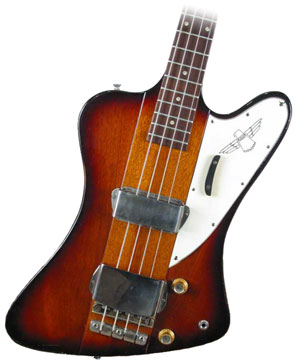
The reverse body Gibson Thunderbird
The Gibson Thunderbird bass was launched in 1963 as a response to the long-scale solid-bodied Fender basses that were doing so well at the time (Fender Jazz and Precision). This was a high end instrument, and retailed at slightly more than Fenders offerings. There were two versions, the single pickup Gibson Thunderbird II and the dual pickup Gibson Thunderbird IV. In the July 1963 pricelist, the Thunderbird II was $260 and the IV was $335; compared to $229.50 for a Fender Precision and $279.50 for the Fender Jazz.
New features
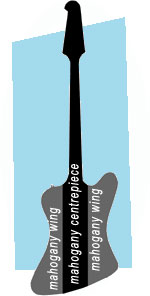
Aswell as being Gibson's first long scale bass, it had their first fully-adjustable bass bridge, and was the first Gibson bass to utilize neck-through construction. This idea had first been used on an electric bass six years earlier by Rickenbacker (the 4000 bass), and consisted of one central piece (or laminate) of wood spanning the entire length of the instrument, and 'wings' glued to the sides to make the body. This contrasted the separate neck and body approach of most guitar makers who normally glued (Gibson) or bolted (Fender) the neck to the body.
The central wood was raised slightly and accommodated tuners, pickups, bridge and the tailpiece. Having the entire length of the strings vibrating on one piece of wood increases sustain, and has added strength for long necks. It is a technique still widely used today on higher end guitars and basses; most notably Rickenbacker and B.C. Rich (and many more besides). The mahogany wings were glued on using a V-shaped notch and groove arrangement. This construction method is unchanged in today's Thunderbird IVs.
Early Thunderbird publicity
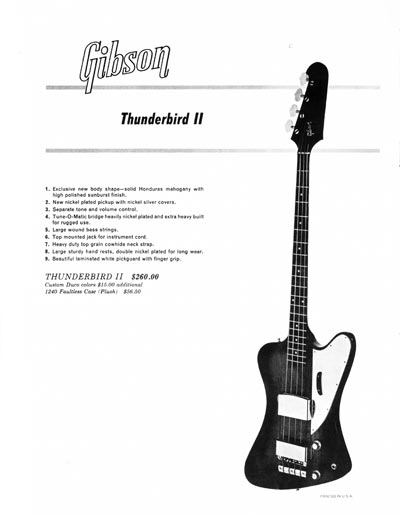
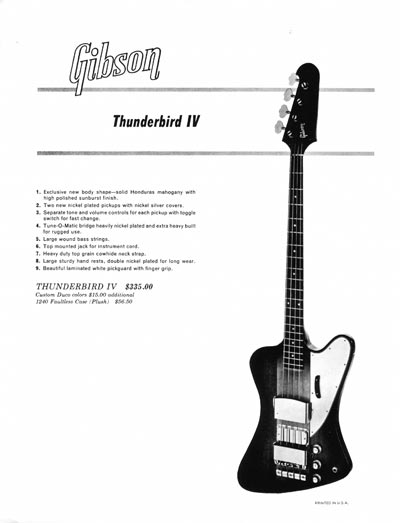
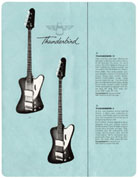
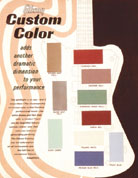
The following publicity sheets were printed in 1963, alongside similar sheets for the full Gibson Firebird range
Gibson Thunderbird shipping totals (1963-1965)
1964 was the peak year, with just 1040 basses produced in this time. The shipping totals by year are as follows:
| 1963 | 1964 | 1965 | total | |
| Thunderbird II | 2 | 501 | 215 | 718 |
| Thunderbird IV | 235 | 87 | 322 |
Sales were not good and Fender complained about similarities to their guitars. Production only lasted from Autumn 1963 until May 1965
Gibson Thunderbird specifications:
- Honduras mahogany body, sunburst finish
- Mahogany through neck, with rosewood fretboard
- 34 1/2 inch scale (actually three eighths of an inch)
- Nickel plated pickup covers, bridge cover and finger rest
- Laminated pickguard with finger grip
- Thunderbird II $260, Thunderbird IV $335, custom Duco colours $15 extra, faultless case (plush) $56.50
Gibson Thunderbird bass for sale

Gibson Bicentennial Thunderbird Bass 1976 - Used, Very Good
Marina del Rey, California, 902**, UNITED STATES OF AMERICA
$5999
Used, very good condition
About this bass: In 1976 Gibson reissued the Thunderbird, in its original early 60s body shape, and seeing as 1976 was the 200th anniversary of American independence, it is known as the bi-centennial model, or Gibson Thunderbird '76. It was only available in limited numbers, with just 1, 855 basses built at Gibson's Kalamazoo plant between 1976 and 1979. Although this bass was modelled directly on the 1963 Thunderbird, ... more


Vintage Gibson Thunderbird Bass Sunburst 1979
Brookfield, Wisconsin, UNITED STATES OF AMERICA
$4999
Vintage Gibson Thunderbird Bass Sunburst 1979
PLEASE CONTACT US WITH ANY QUESTIONS OR FOR AN IN-HAND DESCRIPTION
A great playing Thunderbird in really nice shape for its age with a comfortable feel & terrific tone. Fully inspected & professionally set up by the experts here at Cream City Music, so it's ready to play straight out of the case
Cosmetic Condition: Great shape considering it's 45 years old - various minor nicks, chips, dents & dings; surface scratches ... more
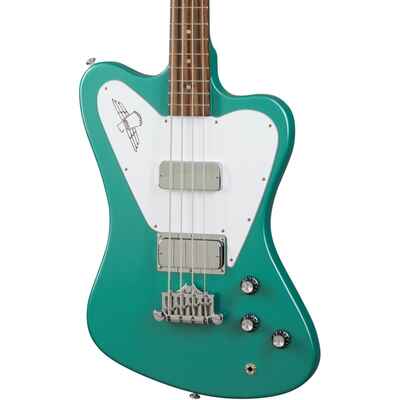
Gibson Non-Reverse Thunderbird Bass Inverness Green
Middletown, New York, 109**, UNITED STATES OF AMERICA
$2198

GIBSON THUNDERBIRD NON-REVERSED BASS GUITAR
New Port Richey, Florida, 346**, UNITED STATES OF AMERICA
$1600
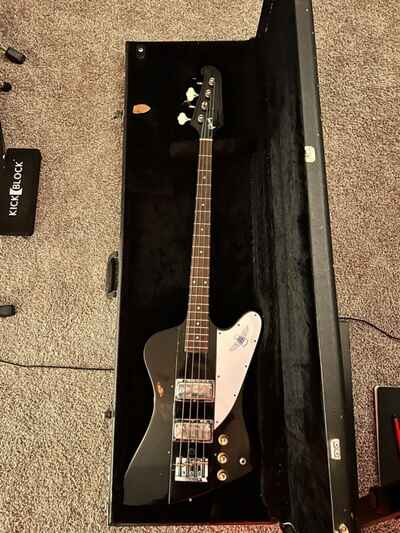
1976 Gibson Thunderbird Bicentennia Ebony
Antioch, Tennessee, 370**, UNITED STATES OF AMERICA
$4145
... more
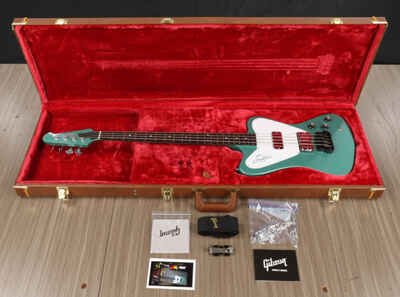
Gibson Thunderbird 4-string Solidbody Electric Bass Guitar - Inverness Green
Fort Wayne, Indiana, 468**, UNITED STATES OF AMERICA
$1500
Used Condition
4-string Electric Bass with Mahogany Body and Neck, Rosewood Fingerboard, and 2 Humbucking Pickups - Inverness Green
8 6 lbs
In good condition. There is a finish chip under the bass edge of the truss rod cover; there are dents in the bass edge of the fretboard at the 2nd and 5th frets. The electronics have been tested as good. The stock bridge has been replaced with a black Hipshot Supertone bridge and it is included inside the case along with all the pictured ... more
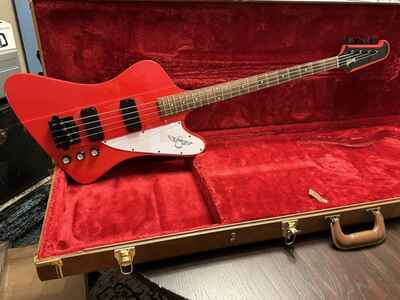
Gibson Thunderbird Bass Guitar
Easley, South Carolina, 296**, UNITED STATES OF AMERICA
$2500
... more

1964 Gibson Thunderbird II Bass the mintest 100% original Polaris White example.
Fort Lauderdale, Florida, 333**, UNITED STATES OF AMERICA
$44995

2022 Gibson Non-Reverse Thunderbird Pelham Blue Electric Bass Guitar #47868
Burbank, California, 915**, UNITED STATES OF AMERICA
$1799
eBay Template Design by OCDesignsOnline HomeAboutTestimonialsPoliciesContactSell your Gear 2022 Gibson Non-Reverse Thunderbird Pelham Blue Electric Bass Guitar #47868 ××××××××××××××××××××××××××××××××××× Item DescriptionWORKING CONDITION: Excellent - Plays great. All of the electronics and controls are working ... more

60's EPIPHONE by GIBSON EMBASSY BASS USA - THUNDERBIRD SOUND - LONG SCALE
COLOGNE, GERMANY
€3333
60's Epiphone by Gibson Embassy Deluxe Bass - made in USA:
+ mahogany body finished in wine red, has lots of weather checking and wear, several extra screw holes on back
+ mahogany neck with rosewood fingerboard, LONG SCALE, has 4 minor SURFACE stress cracks below tuners=check last 3 pics
* skinny neck profile on back around first 5 frets
+ new Fender Reissue tuners
+ 1 original THUNDERBIRD pickup & 1 newer Fender Jazz bass single coil
+ new pickguard
+ new pots and ... more

60er EPIPHONE von GIBSON EMBASSY DELUXE BASS - hergestellt in USA - THUNDERBIRD SOUND
COLOGNE, GERMANY
£2998
+ mahogany body finished in wine red, has lots of weather checking and wear, several extra screw holes on back
+ mahogany neck with rosewood fingerboard, LONG SCALE, has 4 minor SURFACE stress cracks below tuners=check last 3 pics
* skinny neck profile on back around first 5 frets
+ new Fender Reissue tuners
+ 1 original THUNDERBIRD pickup & 1 newer Fender Jazz bass single coil
+ new pickguard
+ new pots and ... more

Gibson USA Thunderbird Bass (Reverse) Bicentennial '76 Natural Finish & HSC 1976
Cowbridge, CF71***, UNITED KINGDOM
£2495
For sale, an incredibly rare, one of just 224 made in 1976, Gibson Thunderbird Bass. Reverse body, known as the Bicentennial '76 model
Back of headstock stamped:
00 214303Dating to 1976, origin Kalamazoo
Specification:Mahogany centerpieceMahogany wingsSunburst, Natural, Ebony and White finishesRosewood fretboard34 1 / 2 inch scale (actually three eighths of an inch)Chrome plated pickup covers, ... more

1987 Gibson Bass IV - hergestellt in den USA - THUNDERBIRD TONABNEHMER
COLOGNE, GERMANY
£1090
* the black painted part of the body was cut off before by some moron and replaced with 2 pieces of ash=
check pic 5
* pearl white finish is very worn
* Thunderbird pickups
* black Schaller hardware
* ebony fingerboard, frets are fine
... more

1989 Jackson Thunderbird Basshülle - Made in USA - passt GIBSON
COLOGNE, GERMANY
£250
+ fits also Gibson T-Bird models
+ black interior with formfit cut, some wear
+ tolex has a LOT of wear and larger rips on back and front
+ leather ends have rips
+ right latch is broken
+ worn but ROCK SOLID
... more
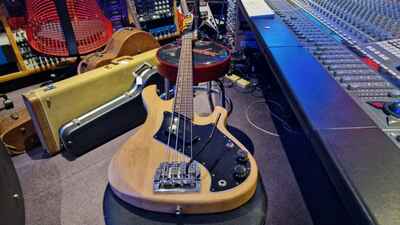
Gibson Victory Bass 1981 Vintage USA Kahler Tremolo Thunderbird Headstock
Southend-on-Sea, SS1***, UNITED KINGDOM
£1999

Gibson USA Thunderbird Reverse Bass Natural Tobacco With Original Hard Case
Launceston, PL15***, UNITED KINGDOM
£2000
The traditional 9-ply mahogany / walnut neck through body construction provides a thundering low end response and a piano like sustain.
The narrow nut width and rounded neck profile neck feels both fast and intuitive. The Thunderbird high output, ceramic magnet loaded humbucking pickups (neck and bridge) deliver the sonic and iconic ... more