

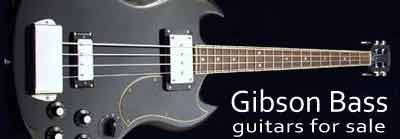
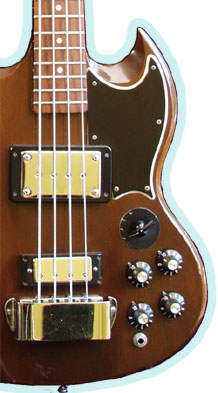
The Gibson EB3 is a true design classic. Not many basses are as easily recognizable, and as often copied; though rarely do imitators capture the unique sound of the bass, which can range snarling treble to subsonic dub
For the music I was playing with Tull, the short scale Gibsons had a fullness of tone that was very suited to the sound of the band - Glenn Cornick
There's something about mahogany, there's a warm roundness,there's a character I get from my Thunderbird and EB-3s - Mike Watt
The SG bass
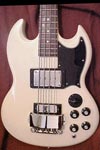
The Gibson EB3 bass came about as a companion bass model to the newly designed Les Paul (SG shape) guitars. It was launched in 1961, first being shown at the NAMM show in July of that year, for general release soon afterwards, with a launch price of $285. Along with the EB0, this was the first Gibson SG bass. Almost 15000 examples were shipped from Gibson's Kalamazoo plant, in Michigan, USA, before the model was finally discontinued in 1979. The Gibson EB3 is an icon of the 1960s, and sales figures for the years 1969-1973 far outstrip the years before or after. More about EB3 pricing and EB3 shipping figures.
The EB0 and EB3 basses had a distinctive sound - in part due to their solid mahogany set-neck construction, and partially due to the pickups - particularly the large humbucker (lovingly dubbed mudbucker - see more about the Gibson EB3 pickup) in the neck position. The bass also came with a varitone switch for four distinct tones - including an incredibly bassy choked neck-pickup sound, often referred to as 'mud' by EB3 fans and detractors alike. Listen to EB3 soundclips
Have a closer look (and listen) to some of these EB3 basses:
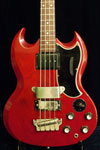
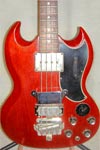
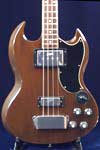
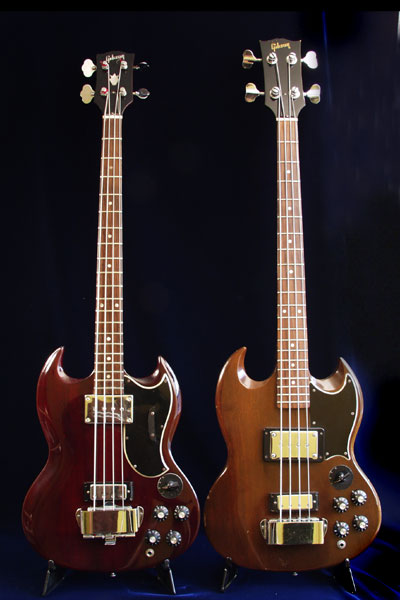
Two EB3s: 1969 EB3 (Cherry finish), and a 1972 EB3 (walnut)
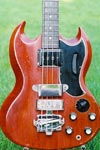
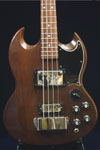
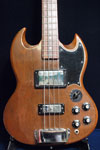
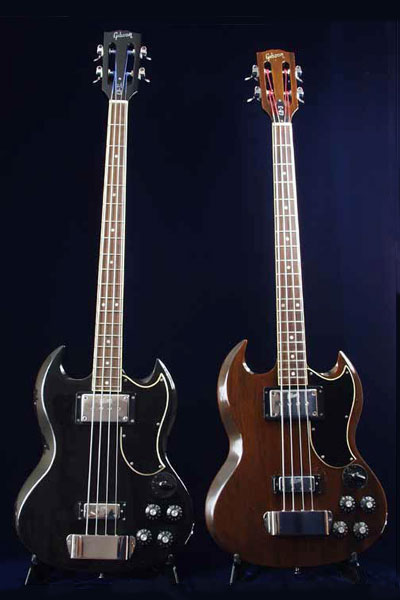 Two EB3s: 1971 EB3L (ebony), and a 1971 EB3 (walnut finish)
Gibson EB3 model changes
The evolution of the EB3 bass followed a very similar path to its sibling the EB0; changes in design happened at the same time, except that the EB3 never existed in the Les Paul Junior cutaway style of the 1960 EB0. The EB3 sported a solid mahogany body, 30 1/2 inch scale, mahogany (initially) one-piece neck with rosewood fingerboard, and built in string mute, to give an upright bass sound. Of course, the design was continually tweaked throughout the eighteen years it was built, with the most significant change happening in 1972; by this time the Gibson EB3 had a three piece maple neck, and was noticeably chunkier than previously. There is a more detailed examination of the subtle design changes that occurred over the production run of this bass here.
The beginning of the seventies saw the first major redesign of the bass; the shorter scale length had been seen as one of the EB3s weak points, so a long scale EB3L was produced along side regular shortscales. Interestingly the new long scale versions never exceeded the sales of short scale basses at any point, despite being the same price.
By late 1971/early 1972, the series was being redesigned again, but more drastically this time. Necks became maple, pickups were repositioned and circuits redesigned. Underbridge mutes were phased out entirely.
The 1960s EB3 was a small bass, as well as being only 30 1/2 scale, it weighed a mere 3.7 kg (compared to 4.6 kg of a 1970s EB3).
Some early seventies basses had a piece of foam rubber glued to the underside of the bridge cover, in order to act as a mute, but these again were usually removed.
The 1960s Gibson EB3 was very popular with the British bands of the late 1960s. People like Jack Bruce (Cream), Andy Fraser (Free), Bill Wyman (Rolling Stones), Trevor Bolder (David Bowie), Glenn Cornick (Jethro Tull), and Chris White (Zombies) all used the EB3 as well as a whole host more in the seventies. Today it still used by bassists such as Mike Watt (Iggy and the Stooges) and Jared Followill (Kings of Leon).
The standard finish was translucent Cherry, with Walnut added in 1968, and finally White in 1976. Other Gibson custom colours were available, with Ebony, White and Pelham Blue finishes shipped in the 1960s. These guitars are uncommon and highly sought today. A small number of Natural guitars were built in the early 1970s; these were actually a clearcoat over a light alder wood body; a very different look from the usual dark EB bass.
The following pages summarise technical specifications, (parts lists, schematics) EB3 shipping figures, catalogue appearances and soundclips of the EB3 bass, as well as a closer look at instruments from different years.
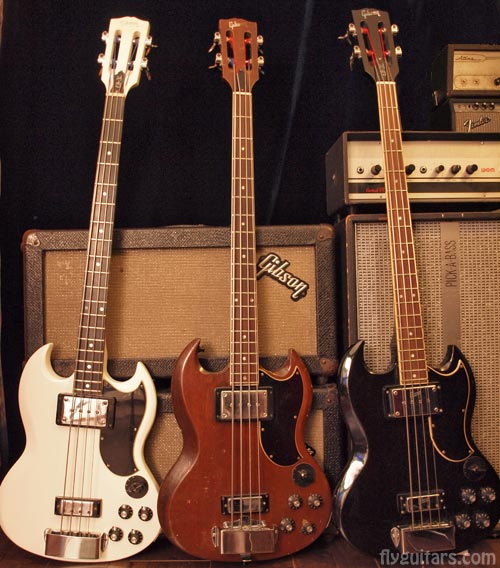
Check out the following EB3s - representing 18 years of production.
- 1961 Gibson EB-3
- 1961 Gibson EB-3 (2)
- 1963 Gibson EB-3
- 1963 Gibson EB-3 (Sunburst)
- 1965 Gibson EB-3 (Pelham blue)
- 1969 Gibson EB-3
- 1971 Gibson EB-3
- 1971 Gibson EB-3L
- 1972 Gibson EB-3
- 1972 Gibson EB-3L
- 1973 Gibson EB-3 (Left hand stereo)
- 1978 Gibson EB-3
similar models
1960s
EB0, EB0F, EB6, Melody Maker bass
1990s
SG-Z
2000s
SG reissue bass, SG supreme, SG standard
Gibson EB3 bass for sale

"1973" Vintage Cherry "GIBSON EB-3" with OHSC Serial #056076 in Great Condition
Riverside, California, 925**, UNITED STATES OF AMERICA
$3795

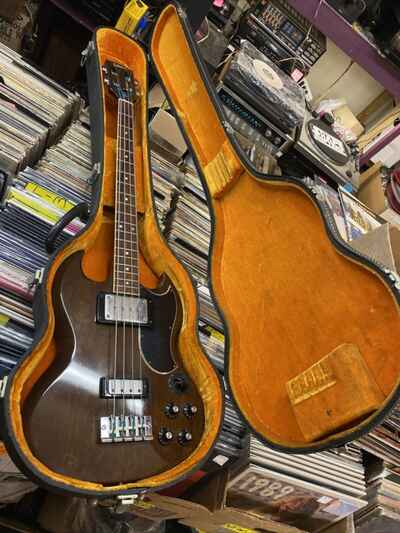
Gibson EB-3 Cherry Mod 1969 Electric Bass Guitar Original Case Slotted Head Art
El Segundo, California, 902**, UNITED STATES OF AMERICA
$3500
... more

Vintage Gibson EB3 Bass Guitar
Upper Sandusky, Ohio, 433**, UNITED STATES OF AMERICA
$2477
... more
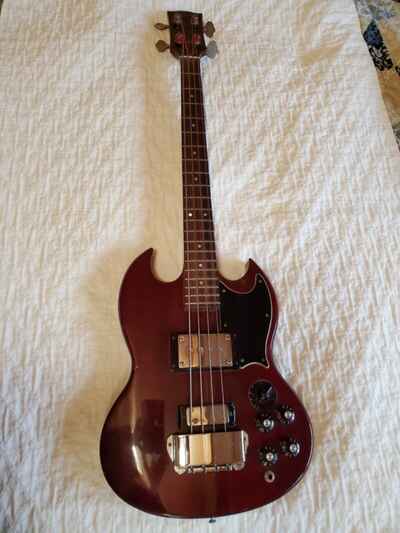
Gibson EB3 Bass Vintage
Edmonton, Kentucky, 421**, UNITED STATES OF AMERICA
$1990
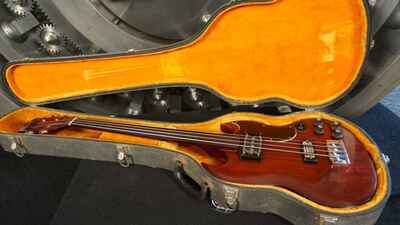
Gibson Slothead EB-3 1971 - Cherry Fretless Bass w / Original Gibson Case
Huntington, Indiana, 467**, UNITED STATES OF AMERICA
$1500
This bass is an absolute monster and sounds incredible! I don't know for sure (I kinda doubt it) that this would have come from the Gibson factory as fretless. However, whoever did the job has done it professionally and it looks great!
The electronics work perfectly and it has that classic "double bass" tone in the first position!
There is some bow in the neck. The truss doesn't ... more

1963 Gibson EB-3 Bass ex Bob Daisley (Rainbow, Black Sabbath)
Doncaster, DN6***, UNITED KINGDOM
£7999
We are happy to offer the following from the personal Private Collection of The Blizzard Himself that Being Bob Daisley whom is Heavy Rocks most distinguished and respected of all Bass Players and Songwriters, details as follows
History
The history and career of Bob Daisley is Legendary and has been one of the main contributors to the sound, look, style of the following Iconic Hard Rock artists some of which are as follows:
Rainbow - Black Sabbath - ... more
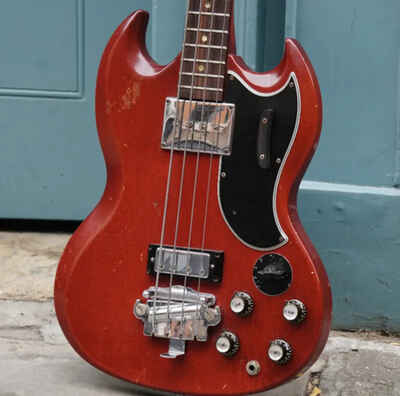
Gibson EB-3 1965 - Cherry Red JACK BRUCE CREAM
Doncaster, DN6***, UNITED KINGDOM
£5499
Internally / Externally Original
Mahogany body / rosewood fretboard
Humbucking pickup in the neck and mini-humbucker in the bridge
Four-way rotary pickup selector switch
Condition 8 / 10
Case
ALL ... more
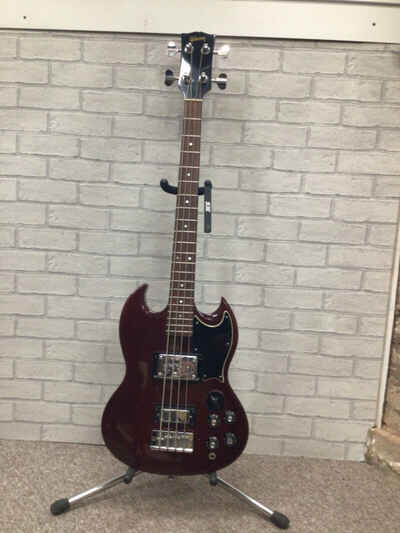
Gibson EB-3 Bass Guitar 1967
Horncastle, LN9***, UNITED KINGDOM
£2950

Gibson EB-3 bass (with slotted headstock) USA / 1971
Donisthorpe, DE12***, UNITED KINGDOM
£2250
EXPORT price is £2250. UK price is £2450, with FREE (mainland) DELIVERY
Rare "slotted headstock" variant of Gibson EB-3, only made twixt 1969-1972. Over 14, 000 EB-3s were hand-made by the Kalamazoo factory ( Michigan / USA), ending in 1979. With set necks (not woodscrews ), and top craftmanship from day one the EB-0 and EB-3 models were played all over the world. Prominent British players were... more

1971 GIBSON EB 3 SLOTTED HEADSTOCK BASS CASE - made in USA
COLOGNE, GERMANY
€444
* CASE ONLY !
* strap that holds case open=GONE
* bottom and top are loose =need reglueing
* tolex has rips
* all latches are working fine
* check all pics
Over 1000 more
GUITARS-BASSES-PARTS in our OTHER
AUCTIONS !!!!
TAKE A LOOK !!!... more
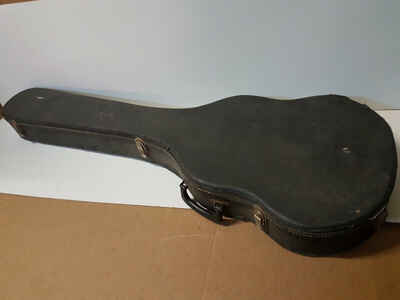
1971 GIBSON EB 3 SLOTTED HEADSTOCK BASS CASE - made in USA
COLOGNE, GERMANY
€399
* CASE ONLY !
* interior has stains
* tolex has rips
* all latches are working fine
* worn but solid
* check all pics
PLENTY of PARTS for SALE
ATTENTION! OVER 1000 more
GUITARS-BASSES-AMPS-PARTS
in our OTHER AUCTIONS !!!
CHECK OUR SHOP OUT -------------->>>>>-------------->>>>>
... more

1971 GIBSON EB 3 SLOTTED HEADSTOCK BASS CASE - made in USA
COLOGNE, GERMANY
€399
* CASE ONLY !
* interior has stains
* tolex has rips
* all latches are working fine
* worn but solid
* check all pics
PLENTY of PARTS for SALE
ATTENTION! OVER 1000 more
GUITARS-BASSES-AMPS-PARTS
in our OTHER AUCTIONS !!!
CHECK OUR SHOP OUT -------------->>>>>-------------->>>>>
... more
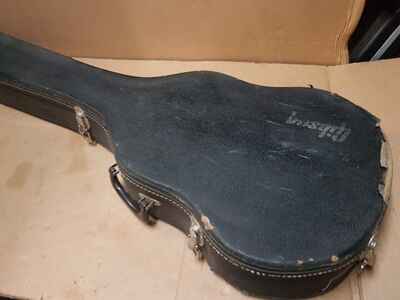
1971 Gibson EB 3 HÜLLE - passt NUR SCHLITZKOPF Version
COLOGNE, GERMANY
£399
* CASE ONLY !
* strap that holds case open=GONE
* bottom and top are loose =need reglueing
* tolex has rips
* all latches are working fine
* check all pics
* SOLD AS IS - NO RETURNS... more

1971 Gibson EB 3 SLOTTED HEADSTOCK BASS CASE - Made in USA
COLOGNE, GERMANY
£345
* CASE ONLY !
* interior has stains
* tolex has rips
* all latches are working fine
* worn but solid
* check all pics
... more
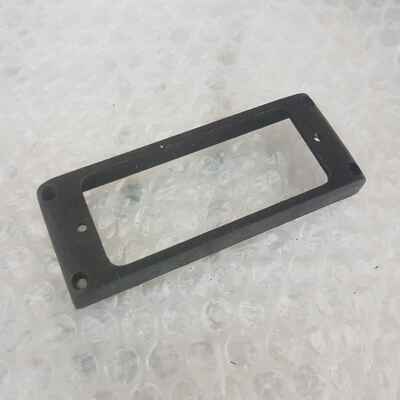


Gibson EB-3L 1973 - Vintage Bass Guitar, Long Scale - Original Hard Case - Rare!
Meadow Heights, VIC, 3***, AUSTRALIA
AU $4895
Long Scale 1973 model bass guitar with original hard case
All pictures supplied with the auction are of the actual item for sale, and indicate its condition
This vintage Gibson is in good playable condition with a clean fingerboard and neck, good fretting and fully functional tuners. This model is fitted with a drop-D tuner (adjustable) which functions well. The pickups and wiring appear original, are operational, and it sounds superb. It has been fitted with a set... more
Thanks for putting up this article on these fine bass guitars. Oh, and don't forget Jim Lea of Slade, he played one, and quite well. I think Dennis Dunaway of Alice Cooper also played an EB-3.
I have a Gibson EB3-L That I bought in 1972 in Detroit Michigan on 6 mile road. It was used and in very good condition and is still the same condition. How can I find out how old is it? Its Cherry with the two cutouts for the tunnig keys. Keys go backwords, not from the sides. Thanks
I bought a Gib EB-3 Cherry from a fella who had too many contacts with the law so I got it in the mid 60's. I've had it since, haven't played it in 40 yrs. Original hard case with bright orange lining. We (Gary Shope & Purple Sage) played it in the 60's on stage a whole summer at Buck Lake Ranch, Angola, IN and sat in with some of the stars of the era, Joanne Castle, Roy Clark, etc., as well as many other places. We were the House Band at Buck Lake. I believe it was in 1967-69.
Hi I am attempting to restore a 1967 EB3 and am short of the Bridge mute attachment, so will have to get one made. Please can you be of assistance in helping me to obtain plans to make one. I have tried Gibson with no luck. Regards Sean Parker
Hi there, Can you help to find saddles and screws for a 1967 Gibson EB 3 bridge? Thank you!!! Rui Costa
Hi, hope you can assist me. Was there a recommended set-up for the EB3? ie what string height at twelth fret? What gauge strings? How did they leave the factory? Did Gibson suggest such things to it's dealers/authorised repairmen?